
Everything you want to know about linear bricks
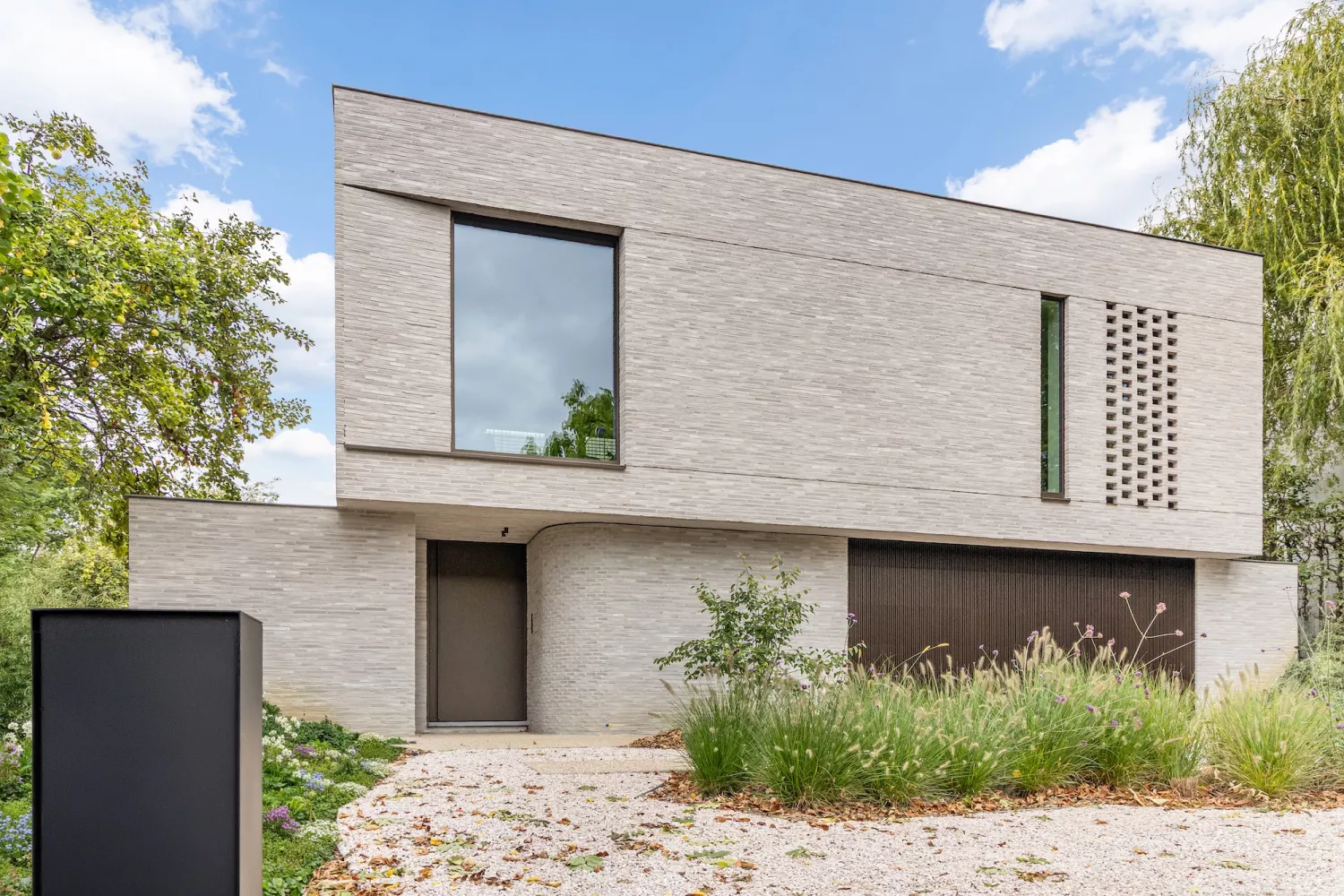
A linear brick is a long, slim facing brick. It stands apart in both format and appearance. Its slender proportions let you draw a stylised play of lines across the façade, and long lines sit naturally in contemporary architecture.
Which designs suit linear bricks?
Linear bricks are often used for cubic houses and villas. They come into their own on wide, low buildings, and on classic houses too. We see them in very different designs: façades built entirely in linear bricks, and façades that play with contrast, for example with render or other clean-lined elements.
How many linear bricks per m²?
How many linear bricks you need per square metre depends on the length of the brick and the thickness of the joint. The thicker the joint, the fewer bricks you need. On average, 62 to 65 linear bricks fit in one square metre.
Linear bricks come in several formats. In our collections they start at 330 to 335 mm and go up to 500 mm.
Which joint suits a linear brick?
Recessed pointing works well with this brick. The mortar sits slightly back between the bricks, which creates a light play of shadow in the wall and makes the façade more lively. It gives the wall a robust look that brings out the crafted character and the slender format. Most contemporary houses are built with recessed joints.
Traditional pointing is of course also possible. That depends entirely on the style and the wishes of the architect or client. The ideal joint thickness is between 7 and 15 mm. You can also play with the vertical joint between the bricks, the perpend. One option is to leave it out altogether, which emphasises the horizontal lines even more with an elegant, serrated line.
Linear bricks are laid according to standard masonry practice. No special method is needed.
Eco-smoked waterstruck bricks in linear format
At Joseph Bricks we produce eco-smoked waterstruck bricks. A waterstruck facing brick has a distinctive texture, a deep colour, characteristic edges and no sand coating. Thanks to the clay we use, it has a higher compressive strength and low water absorption, so it stands the test of time. Our linear bricks are available within 6 to 12 weeks.
Eco-smoking: firing and smoking in one cycle
Bricks are normally fired along a temperature curve of 1,100 degrees and then left to cool slowly. In a second cycle the brick is reheated to 800 degrees and smoked. Firing and smoking often take place at two different sites.
At Joseph Bricks, firing and smoking happen in a single production cycle. We cool the brick to 800 degrees and start smoking straight away, so it does not have to be heated to 800 degrees a second time. This means lower gas consumption and lower CO2 emissions. And because the bricks do not travel between sites, we use less packaging.

